U.S. Dollar Index (DXY) and U.S. Monetary Easing

U.S. Dollar Index (DXY) and U.S. Monetary Easing Fed rate cuts don’t always spell a softer dollar. When viewed as a push to steady the economy, they can fuel near-term demand for the greenback. Image: TS Lombard

U.S. Dollar Around Fed Cuts

U.S. Dollar Around Fed Cuts Typically, the U.S. dollar experiences weakness before the Fed’s initial rate cut, followed by possible strengthening or stabilization as the easing cycle progresses. Image: TS Lombard

S&P 500/MSCI World and U.S. Dollar Trade-Weighted Index

S&P 500/MSCI World and U.S. Dollar Trade-Weighted Index The renewed relative strength and attractiveness of U.S. assets amid global uncertainty and monetary policy differentials have played a central role in driving the U.S. dollar’s recent rebound Image: Goldman Sachs Global Investment Research

Trade-Weighted U.S. Dollar

Trade-Weighted U.S. Dollar Amid trade-related uncertainty and tariffs weighing on U.S. growth and investor sentiment, Goldman Sachs expects the U.S. dollar to decline further, potentially providing a tailwind for mega-cap tech stocks. Image: Goldman Sachs Global Investment Research

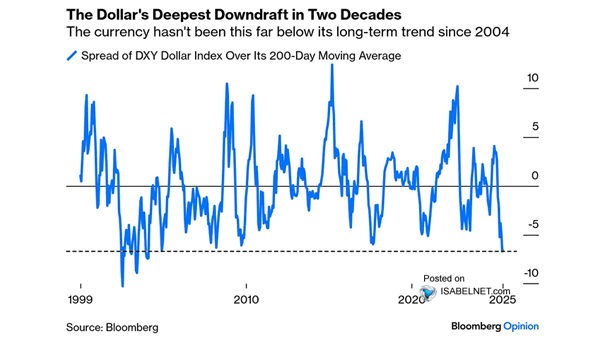
U.S. Dollar and 200-Day Moving Average

U.S. Dollar and 200-Day Moving Average The DXY dollar’s current position well below its 200-day moving average marks a rare bearish phase, the likes of which have not been seen in two decades, signaling a challenging environment for the U.S. dollar in the near term. Image: Bloomberg
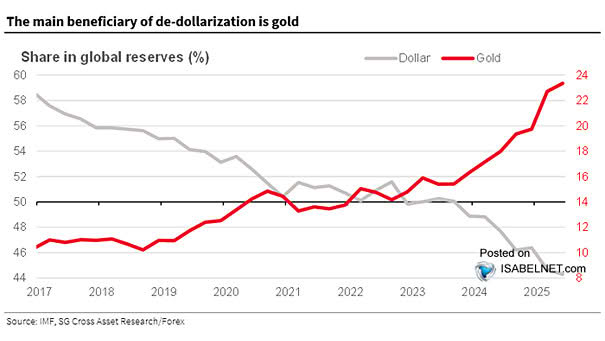
U.S. Dollar vs. Gold – Share in Global Reserves

U.S. Dollar vs. Gold – Share in Global Reserves As countries and central banks seek to reduce their reliance on the U.S. dollar for reserves and international trade, gold has emerged as the preferred alternative asset. Image: Societe Generale Cross Asset Research

Performance – S&P 500 vs. 30-Year US Treasury vs. Trade-Weighted U.S. Dollar

Performance – S&P 500 vs. 30-Year US Treasury vs. Trade-Weighted U.S. Dollar The simultaneous decline of U.S. equities, bonds, and the dollar is rare—especially during periods of market stress— and signals a potential shift in global investor sentiment and the structural underpinnings of U.S. financial markets. Image: Goldman Sachs Global Investment Research

The U.S. Dollar and Reserve Status

The U.S. Dollar and Reserve Status Could the U.S. dollar lose its status as the world’s dominant reserve currency? Historically, leading reserve currencies have held their status for about a hundred years. Image: TS Lombard

U.S. Dollar Exposure of Currency Hedge Funds

U.S. Dollar Exposure of Currency Hedge Funds Hedge funds have significantly increased their bearish bets against the U.S. dollar, reflecting widespread expectations that the dollar will weaken further against other major currencies. Image: J.P. Morgan

Aggregate U.S. Dollar Position, Non-Commercial Traders

Aggregate U.S. Dollar Position, Non-Commercial Traders Speculators are holding their most bearish positions on the U.S. dollar since September 2024, driven by global optimism, de-dollarization trends, and relative strength in other major currencies. Image: Bloomberg