S&P 500 Yearly Performance During Bull Markets

S&P 500 Yearly Performance During Bull Markets History favors the bulls: since 1950, only once has an S&P 500 bull market ended in its fourth year—history therefore favors further upside over a transition to bear market. Image: Carson Investment Research Click the Image to Enlarge

S&P 500 Yearly Performance During Bull Markets

S&P 500 Yearly Performance During Bull Markets Now in its fourth year, the bull market shows little sign of tiring. History still favors the bulls—since 1950, this phase of the cycle has usually meant more upside, not a break into bear territory. Image: Carson Investment Research

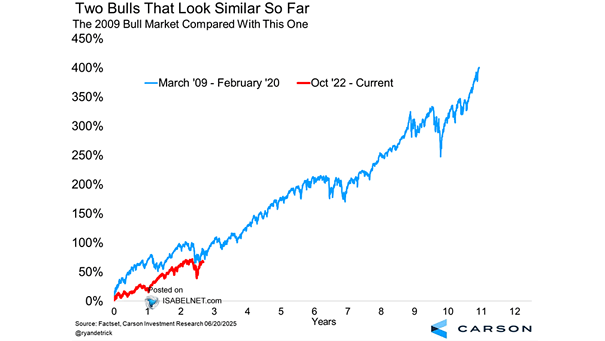
The 2009 S&P 500 Bull Market Compared With This One

The 2009 S&P 500 Bull Market Compared With This One No market cycle is identical, but the S&P 500’s path since 2022 looks like a remix of the 2009–2020 bull market—same mid‑cycle pullback, same setup for another leg higher, much to the bulls’ delight. Image: Carson Investment Research

S&P 500 Bull Markets

S&P 500 Bull Markets Eight years and 288% gains—that’s on average the bull market playbook over the past 50 years. As today’s bull market enters its third year, there’s reason to believe the party is far from over. Image: Carson Investment Research

S&P 500 – Length and Severity of Bear and Subsequent Bull Markets

S&P 500 – Length and Severity of Bear and Subsequent Bull Markets Since 1970, the typical bear market lasts roughly 14 months, experiencing an average decline of around 38%, and is followed by bull markets that last about 70 months and generate average returns of 221%. Image: J.P. Morgan Asset Management

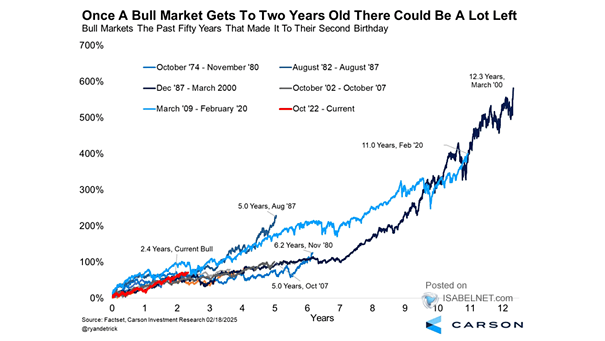
Length of Bull Markets and When They Started

Length of Bull Markets and When They Started The current bull market, which began in October 2022, remains relatively young by historical standards and could persist much longer than bearish observers expect. Image: Carson Investment Research

S&P 500 Bull Markets

S&P 500 Bull Markets The current bull market, which began in October 2022, is showing potential for continued growth at 28 months old. Historically, bull markets have lasted an average of 5.5 years since 1949, with an average gain of 191.6%. Image: Carson Investment Research

S&P 500 Average Returns in Bull Markets

S&P 500 Average Returns in Bull Markets While the third year of a bull market often shows signs of relative weakness, patient investors may find substantial opportunities in the following years, as historical trends suggest the potential for sustained growth. Image: Carson Investment Research

S&P 500 Return – Year 3 of Bull Market

S&P 500 Return – Year 3 of Bull Market Like a kid who loses interest in his favorite toy after two years, the S&P 500 tends to slow down in the third year of a bull market. Its gains often become less impressive compared to the first two years. Image: MarketDesk

Percentage Change in S&P 500 in Previous Bull Markets

Percentage Change in S&P 500 in Previous Bull Markets The current bull market appears to be in its early stages, with historical data supporting the potential for significant gains in the coming months and years. Image: Bloomberg