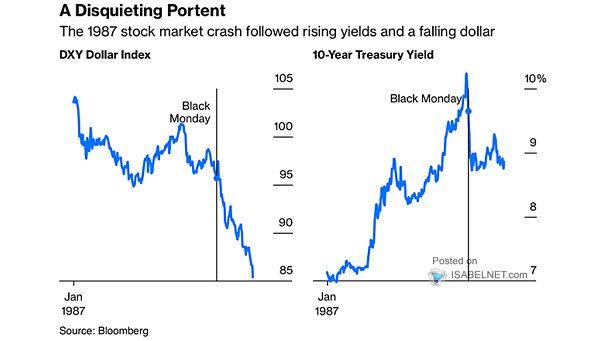
1987 Market Crash – DXY Dollar Index and 10-Year UST Yield

1987 Market Crash – DXY Dollar Index and 10-Year UST Yield Bond yields rarely rise while the dollar falls, as higher yields usually boost currency appeal. This unusual trend signals waning confidence, similar to the pattern seen before the 1987 Black Monday crash. Image: Bloomberg
Emerging Market Currencies Crash

Emerging Market Currencies Crash Emerging market currencies have been pummeled by the coronavirus pandemic and the oil crisis. Image: Financial Times

Was the US Stock Market Crash on October 19, 1987, a “Black Swan” Event?

Was the US Stock Market Crash on October 19, 1987, a “Black Swan” Event? A “Black Swan” is a metaphor that describes an event that comes as a surprise with a major effect, which is extremely difficult to predict. The theory was developed by Nassim Nicholas Taleb. The US stock market on October 19, 1987,…

Margin Debt and Net Investor Credit Balance

Margin Debt and Net Investor Credit Balance NYSE margin debt just blew past $1.5 trillion. Investors are piling into leverage with both hands, leaving little room for error. The market has gotten riskier, more fragile, but that doesn’t mean a crash is guaranteed. Image: Real Investment Advice

S&P 500 CAPE Ratio vs. U.S. Households Holding of Equities % Total Financial Assets

S&P 500 CAPE Ratio vs. U.S. Households Holding of Equities % Total Financial Assets When everyone is piled into equities and valuations are stretched, there isn’t much cushion left. History doesn’t say a crash has to follow, but it does show that markets priced for perfection rarely handle surprises well. Image: Topdown Charts

Two-Month Change in the S&P 500 Since WWII

Two-Month Change in the S&P 500 Since WWII Since WWII, two-month rallies of this magnitude in the S&P 500 have been rare, typically appearing either in the rebound from recessions such as the GFC and Covid-19, or just ahead of the 1987 crash. Image: Deutsche Bank