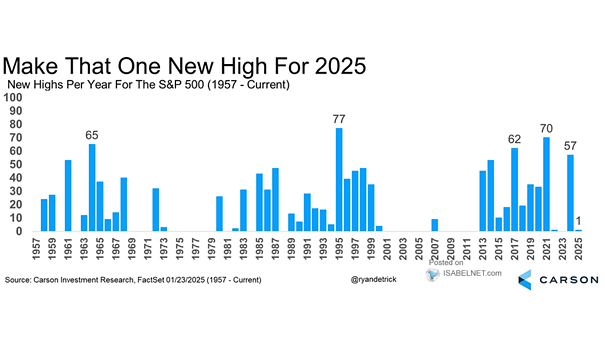
New S&P 500 Index All-Time Highs Per Year

New S&P 500 Index All-Time Highs Per Year The S&P 500 has reached 25 record highs this year. In robust bull markets, new highs usually come in clusters and last longer than the crowd expects, as long as earnings and growth stay on track. Image: Carson Investment Research

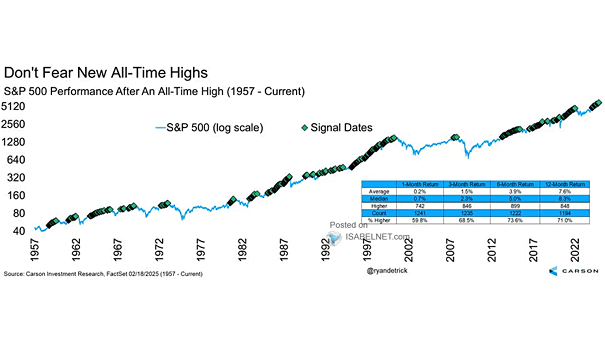
S&P 500 – Investing at All-Time Highs vs. All Other Days

S&P 500 – Investing at All-Time Highs vs. All Other Days Investing at all-time highs tends to spook investors, but the data suggests otherwise: S&P 500 forward returns have typically looked much like those from any other day. Missing the market has usually cost more than buying at the top. Image: Carson Investment Research

S&P 500 Returns After Fed Cuts Within 2% of an All-Time High

S&P 500 Returns After Fed Cuts Within 2% of an All-Time High Bears are losing ground as history leans bullish. Since 1980, when the Fed has eased policy while the S&P 500 traded within 2% of an all‑time high, the index has risen every time in the next 12 months, averaging a 14.2% gain Image:…

S&P 500 Returns After Fed Cuts At All-Time Highs

S&P 500 Returns After Fed Cuts At All-Time Highs Bulls are smiling for good reason: Every time since 1983, rate cuts with the S&P 500 at record highs have been a winning formula — stocks have risen a median 15.2% over the next 12 months. Image: Carson Investment Research

S&P 500 Returns After New All-Time Highs

S&P 500 Returns After New All-Time Highs Since 1990, despite periods of volatility, the S&P 500 has typically continued rising after new all-time highs, with a median 12-month gain of 13.5% and positive returns more than 82% of the time. Image: Carson Investment Research

S&P 500 Performance After an All-Time High and Then Four Red Days in a Row

S&P 500 Performance After an All-Time High and Then Four Red Days in a Row The S&P 500 has fallen for four consecutive days after reaching a record high. Despite short-term challenges, the 12-month outlook remains positive, with positive returns 80% of the time and a median gain of 11.6% since 1990. Image: Carson Investment…

S&P 500 Performance After Fed Cuts Within 2% of All-Time Highs

S&P 500 Performance After Fed Cuts Within 2% of All-Time Highs Bulls rejoice! Since 1980, when the S&P 500 was within 2% of its all-time high during a Fed rate cut, it has been positive 100% of the time over the following 12 months, with an average gain of 13.9%. Image: Carson Investment Research

S&P 500 Performance When >2% Daily Gain at an All-Time High

S&P 500 Performance When >2% Daily Gain at an All-Time High Since 1950, the S&P 500 index has demonstrated robust performance in the year following a daily gain of over 2% at an all-time high, with a median increase of 12.4%. Image: Carson Investment Research

% of Days per Year to Make a New All-Time High for the S&P 500

% of Days per Year to Make a New All-Time High for the S&P 500 The S&P 500’s performance this year reflects a strong bullish trend, with over one-fifth of trading days achieving new all-time highs, underscoring a favorable market environment. Image: Carson Investment Research

S&P 500 Returns After 20 or More All-Time Highs at Midpoint of the Year

S&P 500 Returns After 20 or More All-Time Highs at Midpoint of the Year Since 1950, when the S&P 500 index has made 20 or more all-time highs by mid-year, the full year has been positive 100% of the time, with an average of 20 new all-time highs in the second half. Image: Carson Investment…

S&P 500 Performance After New All-Time Highs On All Five Days of the Week

S&P 500 Performance After New All-Time Highs On All Five Days of the Week When the S&P 500 hits new all-time highs on all five days of the week, historical data suggests a bullish outlook over the next 12 months, with a median return of 8.7% since 1950. Image: Carson Investment Research