U.S. Stock Market Bull and Bear Indicator – S&P 500

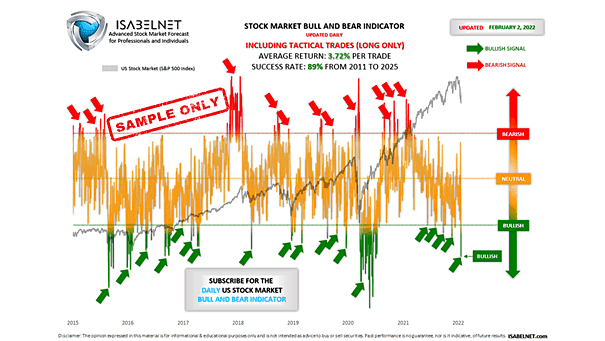
U.S. Stock Market Bull and Bear Indicator – S&P 500 Last Friday, our Stock Market Bull & Bear Indicator was bullish well before the opening bell and the S&P 500 didn’t disappoint, ending the day up 0.65%. Using multiple financial data, this great model helps investors navigate through different market conditions. It suggests whether the…

Average S&P 500 Performance Around Bear Markets and Corrections

Average S&P 500 Performance Around Bear Markets and Corrections U.S. stocks have a history of pushing higher toward bull market peaks before eventually pulling back. In such periods, corrections tend to be brief, with rebounds coming faster than during deeper bear cycles. Image: Goldman Sachs Global Investment Research

Bear Market – Number of S&P 500 Stocks Down 20% or More

Bear Market – Number of S&P 500 Stocks Down 20% or More More than a third of S&P 500 stocks are down 20% or more, even as the index holds up. It’s a reminder that market breadth is thinning, often a sign of late-cycle fatigue. Image: Societe Generale Cross Asset Research

AAII Bulls Minus Bears and S&P 500 Returns

AAII Bulls Minus Bears and S&P 500 Returns The AAII bulls minus bears sentiment spread in 2025 has mirrored bear market extremes from history, reflecting deep pessimism over near‑term stock performance — but to contrarians, that gloom looks like opportunity. Image: Carson Investment Research

Cumulative Bull vs. Bear Markets

Cumulative Bull vs. Bear Markets Why do bear markets matter? Because most of the gains of an inflation-adjusted bull run can be erased when the next downturn hits. Image: Real Investment Advice

AAII Investor Sentiment Bull Minus Bear Spread

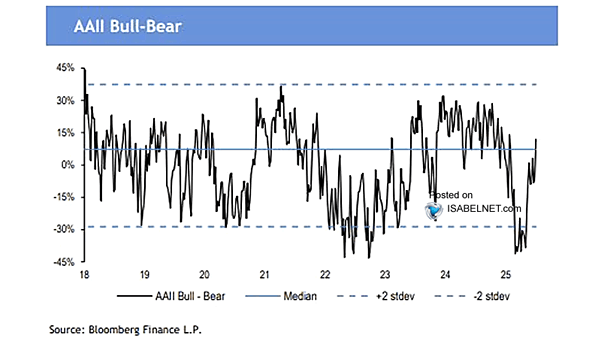
AAII Investor Sentiment Bull Minus Bear Spread The AAII bull-bear spread points to a balanced mood among U.S. retail investors who expect stock prices to decline in the near term—a condition that could set the stage for a sharper move in either direction. Image: Deutsche Bank Asset Allocation

S&P 500 – Length and Severity of Bear and Subsequent Bull Markets

S&P 500 – Length and Severity of Bear and Subsequent Bull Markets Since 1970, the typical bear market lasts roughly 14 months, experiencing an average decline of around 38%, and is followed by bull markets that last about 70 months and generate average returns of 221%. Image: J.P. Morgan Asset Management

AAII U.S. Investor Sentiment Bearish Readings

AAII U.S. Investor Sentiment Bearish Readings While AAII U.S. investor pessimism has eased to a 20-week low, bearish sentiment remains modestly elevated relative to historical averages, indicating that caution lingers even as market conditions improve. Image: The Daily Shot

S&P 500 Performance After at Least 15 Weeks of AAII Bears over Bulls Ends

S&P 500 Performance After at Least 15 Weeks of AAII Bears over Bulls Ends A streak of 15 consecutive weeks with more bears than bulls in the AAII survey is rare—only four other periods have lasted this long. In each case, the S&P 500 was higher 12 months later, with an average gain of 27.5%.…