Cash Allocation by Non-Bank Investors Globally

Cash Allocation by Non-Bank Investors Globally “Cash is king” is starting to sound like a relic. Non-bank investors globally are holding less cash than at any time since at least 1999, leaving financial markets exposed to sudden shocks. Image: J.P. Morgan

Equity Allocation as % of Household Financial Assets

Equity Allocation as % of Household Financial Assets Equities dominate household portfolios in the U.S., Australia, and Sweden, but caution still rules in Europe and Japan, where cash and liquid assets remain king. Image: Goldman Sachs Global Investment Research

U.S. Households’ Allocation to Equity, Bond and Cash

U.S. Households’ Allocation to Equity, Bond and Cash Americans have never been so invested—literally—in the market, with household equity allocations at all-time highs, a boom shadowed by warnings of how sentiment can sour overnight. Image: Goldman Sachs Global Investment Research

Volatility Control Funds Estimated Equity Allocation

Volatility Control Funds Estimated Equity Allocation Vol-control funds have near-record equity exposure by historical standards, sitting at the 97th percentile, which reflects strong confidence in the equity market risk environment. Image: Deutsche Bank Asset Allocation

U.S. Households’ (Incl. Hedge Fund) Asset Allocation

U.S. Households’ (Incl. Hedge Fund) Asset Allocation U.S. households are currently heavily overweight in equities relative to fixed income, reflecting strong conviction in U.S. equity markets despite ongoing economic uncertainties and cautious positioning in bonds. Image: Deutsche Bank
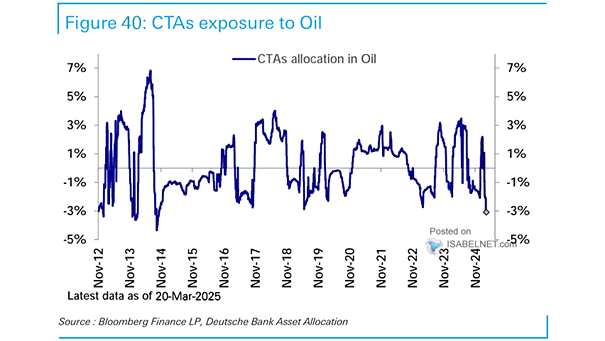
CTAs Allocation in Oil

CTAs Allocation in Oil Given the current market climate, Commodity Trading Advisors have notably raised their exposure to oil. Image: Deutsche Bank Asset Allocation

AAII – U.S. Retail Investors Allocation to Stocks, Bonds and Cash

AAII – U.S. Retail Investors Allocation to Stocks, Bonds and Cash High equity allocations and low cash positions don’t always mean a market reversal is near. However, they suggest that much of the market’s potential gains may already be priced in, as investors have heavily committed to equities. Image: Real Investment Advice

Household Asset Allocation

Household Asset Allocation The wealth gap between the rich and the middle/lower classes is significantly influenced by their asset ownership patterns. The wealthy predominantly own equities, while the middle and lower classes tend to invest heavily in real estate. Image: Goldman Sachs Global Investment Research

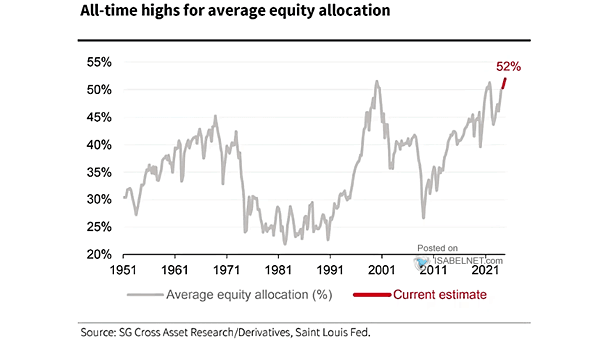
Implied Equity Allocation by U.S. Households

Implied Equity Allocation by U.S. Households Periods of high household equity allocation have historically been followed by lower market returns, implying that current trends might indicate potential risks for future investors. Image: J.P. Morgan