Wealth and Spending by Income Quintile in the U.S.

Wealth and Spending by Income Quintile in the U.S. The middle 60% of Americans control just 26% of the nation’s wealth but account for more than half of all spending. Whether they can keep it up depends on how long the labor market stays strong. Image: J.P. Morgan Asset Management

Bloomberg’s Global 60/40 Equity/Fixed Income Portfolio

Bloomberg’s Global 60/40 Equity/Fixed Income Portfolio Reaching a new all-time high, the global 60/40 portfolio has demonstrated renewed strength and remains a cornerstone strategy for long-term investors who prioritize diversification, balance, and moderate risk tolerance. Image: Deutsche Bank

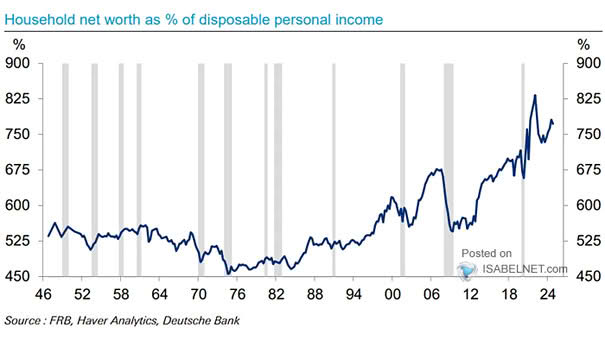
U.S. Household Net Worth as % of Disposal Personal Income

U.S. Household Net Worth as % of Disposal Personal Income While the U.S. household net worth has risen to historic levels due to assets like stocks and real estate, AI-driven financial gains mainly benefit the richest, increasing the wealth gap. Image: Deutsche Bank

S&P 500 Market Capitalization to Real Disposable Personal Income

S&P 500 Market Capitalization to Real Disposable Personal Income The S&P 500’s market capitalization relative to real disposable personal income has reached a record high of 28 times, surpassing the previous peak of 25 times observed during the 2021 meme stock frenzy—a level never seen before. Image: Real Investment Advice

U.S. Consumers – Stock Prices and Income Expectations

U.S. Consumers – Stock Prices and Income Expectations U.S. consumers are experiencing a notable rise in optimism regarding stock market returns for the next 12 months, but this may lead to disappointment as their outlook on income growth does not reflect the same enthusiasm. Image: Deutsche Bank

Median Real Net Worth by U.S. Income Quantiles

Median Real Net Worth by U.S. Income Quantiles Recovering 2007 levels of median real net worth across all U.S. income quantiles took 15 years—a remarkably long time. Image: Deutsche Bank

U.S. Corporate Income Tax Rate

U.S. Corporate Income Tax Rate The trend of declining effective tax rates among S&P 500 companies reflects broader economic shifts and policy decisions that have shaped the landscape of corporate taxation in the United States. Image: Goldman Sachs Global Investment Research

Stocks – Indexed Consensus NTM Net Income

Stocks – Indexed Consensus NTM Net Income The widening gap in expected net income between mega-cap tech stocks and the bottom 493 stocks of the S&P 500 highlights the concentration risk and volatility associated with the dominance of these tech stocks in the index. Image: Goldman Sachs Global Investment Research

Cumulative Inflows to U.S. ETFs with Derivative Income Strategies

Cumulative Inflows to U.S. ETFs with Derivative Income Strategies Over the course of the past two years, the scale of capital flows into U.S. ETFs via options strategies has increased dramatically, reflecting a shift in investor preferences and strategies. Image: BofA ETF Research

Household Debt-to-Income Ratios

Household Debt-to-Income Ratios U.S. households have improved their balance sheets in the past decade. Image: Deutsche Bank