Policy Uncertainty Index vs. S&P 500 Index

Policy Uncertainty Index vs. S&P 500 Index Policy uncertainty often rattles markets—but those jitters tend to be short-lived, with volatility typically hitting peak levels near market lows. Image: Real Investment Advice

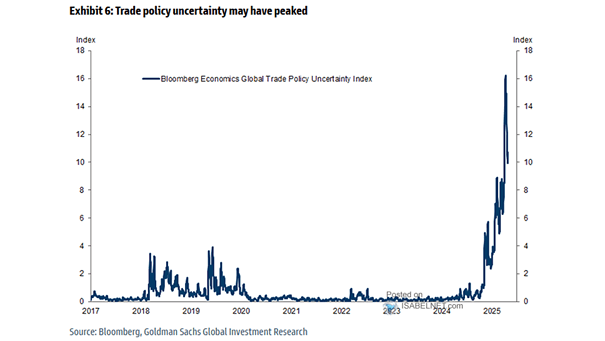
Trade Policy Uncertainty

Trade Policy Uncertainty When trade policy uncertainty peaks, the S&P 500 often posts positive returns. Markets tend to over-discount risks during uncertain periods, and relief rallies are common once worst-case scenarios are avoided or resolved. Image: Goldman Sachs Global Investment Research
Trade Policy Uncertainty Indexes

Trade Policy Uncertainty Indexes Uncertainty in trade policy often leads to positive future returns for the S&P 500, as markets tend to price in worst-case scenarios during unclear times. Once clarity emerges, stocks frequently recover. Image: Deutsche Bank

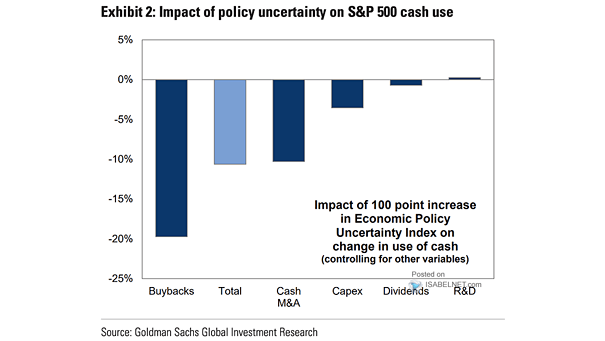
U.S. Economic Policy Uncertainty Index

U.S. Economic Policy Uncertainty Index Uncertainty in economic policy has often led to positive future returns for the S&P 500, as markets anticipate the worst during unclear periods. When the situation becomes clearer, stocks tend to recover strongly. Image: Goldman Sachs Global Investment Research

U.S. Equity Volatility and Global Economic Policy Uncertainty

U.S. Equity Volatility and Global Economic Policy Uncertainty The chart shows that U.S. equity volatility does not mirror global economic policy uncertainty since 2009, perhaps due to strong central bank support. Image: Pictet Wealth Management

Number of U.S. IPOs

Number of U.S. IPOs 40 U.S. companies have gone public so far this year, while Goldman Sachs expects roughly 100 IPOs to raise about $160 billion in 2026. Geopolitical uncertainty and recent equity market volatility have kept issuance in check. Image: Goldman Sachs Global Investment Research