Inequality – The Global Wealth Pyramid

Inequality – The Global Wealth Pyramid The level of wealth inequality is high in 2019: the richest 10% of adults own 82% of global wealth, while the bottom half of adults account for less than 1%. Image: Credit Suisse

Inequality – Wealth per Adult Around the World

Inequality – Wealth per Adult Around the World The U.S. with median wealth per adult at $65.9K, and Canada ($107K), are the wealthiest in the Western Hemisphere. Image: howmuch.net

U.S. Household Wealth

U.S. Household Wealth Stock market gains over the past six years have boosted U.S. household wealth and powered consumer spending, while also heightening vulnerability if markets fall. Image: Deutsche Bank

Breakdown of Household Equity and Mutual Fund Ownership by Wealth Percentile

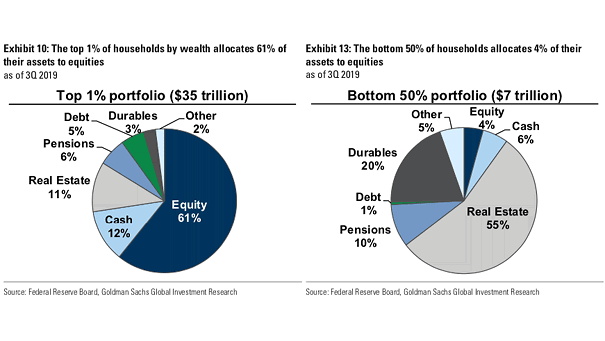
Breakdown of Household Equity and Mutual Fund Ownership by Wealth Percentile Call it the American Dream—or a widening divide. The top 1% own roughly half of America’s market wealth. The bottom half? Just 1%. The gap isn’t closing—it’s widening since 1990. Image: Goldman Sachs Global Investment Research
Inequality – Inflation Adjusted Household Equity Ownership by Brackets

Inequality – Inflation Adjusted Household Equity Ownership by Brackets Wealth inequality in the U.S. may be further exacerbated by the current stock market ownership structure, where 88% of household equity is controlled by just the top 10% of income earners. Image: Real Investment Advice

Inequality – Inflation Adjusted U.S. Household Net Worth by Brackets

Inequality – U.S. Household Net Worth by Brackets The widening wealth gap in the U.S. reflects deep-rooted structural issues that have persisted for decades. While some groups have gained, the overall trend indicates a growing divide that challenges economic mobility and social equity. Image: Real Investment Advice