U.S. M2 Money Supply

U.S. M2 Money Supply With M2 up 4.27% year on year, the money supply is lagging behind economic growth, pointing to cooling inflation rather than trouble. Image: Real Investment Advice

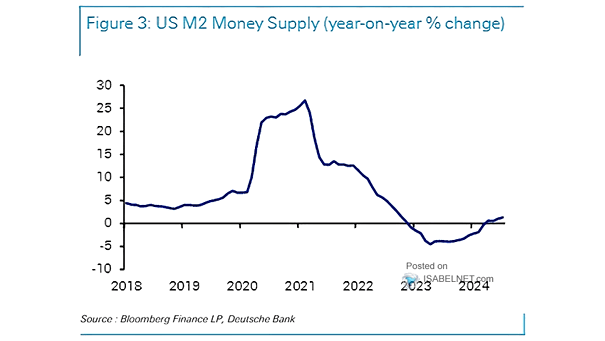
U.S. Money Supply M2

U.S. Money Supply M2 The pickup in the U.S. M2 money supply matters because it signals increasing liquidity that—if excessive relative to economic output and accompanied by rising velocity—could reignite inflationary pressures. Image: Deutsche Bank

M2 Money Supply Growth

M2 Money Supply Growth U.S. money supply growth has robustly returned to near its long-term trend. In contrast, the euro area has experienced a slight slowdown in money supply growth recently, although growth rates remain positive. Image: Deutsche Bank

M2 Money Supply and CPI Inflation

M2 Money Supply and CPI Inflation The significant decline in money supply growth is one of the factors contributing to the contraction of inflation in the United States. Image: Real Investment Advice

Blended Money Supply

Blended Money Supply U.S. money supply is shrinking rapidly. Historically, U.S. nominal GDP growth has closely tracked money supply growth. Image: Deutsche Bank

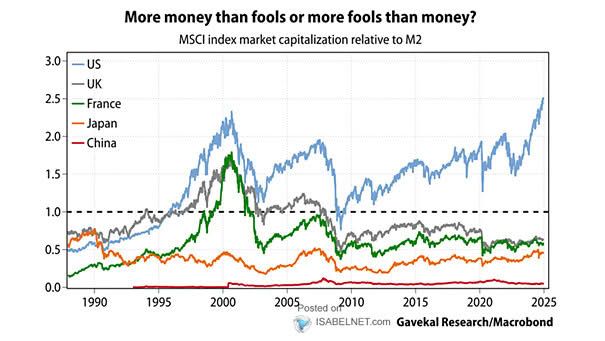
S&P 500 Index vs. M2 Money Supply

S&P 500 Index vs. M2 Money Supply Global M2 money supply growth has a significant impact on U.S. stocks. Image: Morgan Stanley Wealth Management

M2 – Money Supply vs. Monetary Velocity

M2 – Money Supply vs. Monetary Velocity Is printing more money good for the U.S. economy? Despite strong M2 growth, money velocity has declined. Image: Real Investment Advice

M1 Money Supply Growth YoY

M1 Money Supply Growth YoY The M1 money supply in the United States has grown faster than any time in history. Image: Gavekal, Macrobond