U.S. Household Wealth
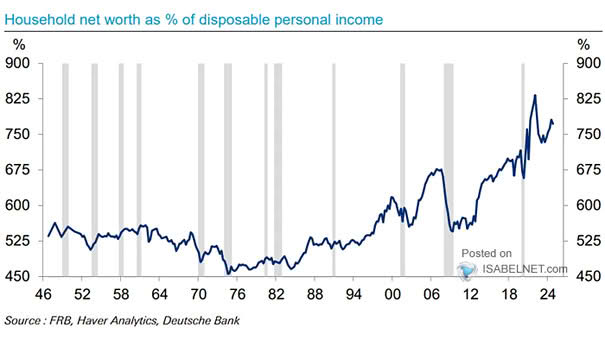
U.S. Household Wealth Stock market gains over the past six years have boosted U.S. household wealth and powered consumer spending, while also heightening vulnerability if markets fall. Image: Deutsche Bank
U.S. Household Equity Ownership vs. S&P 500 Index U.S. households have never been this heavily invested in stocks. The higher the concentration, the greater the risk that a market pullback hits both confidence and consumption, reversing wealth effects. Image: Real Investment Advice
Equity Allocation as % of Household Financial Assets Equities dominate household portfolios in the U.S., Australia, and Sweden, but caution still rules in Europe and Japan, where cash and liquid assets remain king. Image: Goldman Sachs Global Investment Research
S&P 500 CAPE Ratio vs. U.S. Households Holding of Equities % Total Financial Assets U.S. households have never been this deep in equities. It’s a sign of booming wealth and market faith — but also a setup for sharper pain if a correction brings valuations back down to earth. Image: Topdown Charts
Breakdown of Household Equity and Mutual Fund Ownership by Wealth Percentile Call it the American Dream—or a widening divide. The top 1% own roughly half of America’s market wealth. The bottom half? Just 1%. The gap isn’t closing—it’s widening since 1990. Image: Goldman Sachs Global Investment Research
U.S. Households’ Allocation to Equity, Bond and Cash Americans have never been so invested—literally—in the market, with household equity allocations at all-time highs, a boom shadowed by warnings of how sentiment can sour overnight. Image: Goldman Sachs Global Investment Research
Aggregate Financial Asset Allocation Among Households, Mutual Funds, Pension Funds, and Foreign Investors Investor allocation to equities has reached an all-time high, driven by retail enthusiasm and strong performance. However, rising valuations and concentrated leadership call for careful risk management. Image: Goldman Sachs Global Investment Research
U.S. Household Net Worth as % of Disposal Personal Income While the U.S. household net worth has risen to historic levels due to assets like stocks and real estate, AI-driven financial gains mainly benefit the richest, increasing the wealth gap. Image: Deutsche Bank
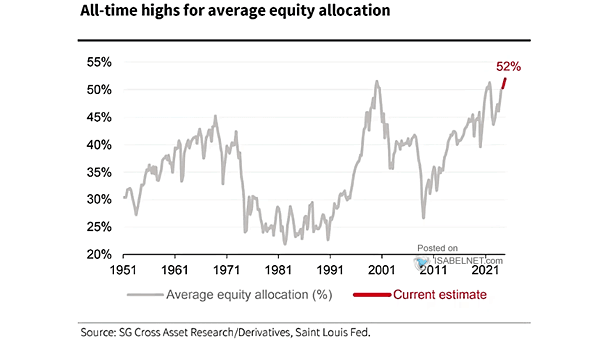
U.S. Household Ownership of Stocks, % of Total Assets An elevated equity exposure among U.S. households does not necessarily signal an imminent market downturn, but it underscores the importance of cautious investment strategies and prudent portfolio management. Image: J.P. Morgan
U.S. Households’ (Incl. Hedge Fund) Asset Allocation U.S. households are currently heavily overweight in equities relative to fixed income, reflecting strong conviction in U.S. equity markets despite ongoing economic uncertainties and cautious positioning in bonds. Image: Deutsche Bank
Equities as a Share of Household Assets U.S. households now allocate about 49% of their assets to equities, a level that reflects strong market optimism and a significant appetite for risk. Image: Goldman Sachs Global Investment Research