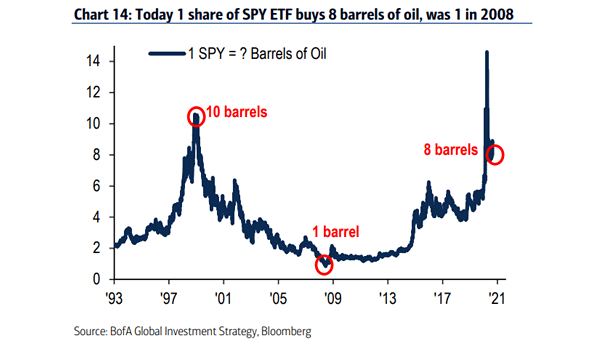
S&P 500 Futures vs. Brent Crude Oil

S&P 500 Futures vs. Brent Crude Oil S&P 500 futures and Brent crude oil have moved in tandem lately, but the correlation has softened this week. Are markets breaking away from oil prices? Maybe investors are focusing more on rates and earnings than commodities now. Image: Deutsche Bank
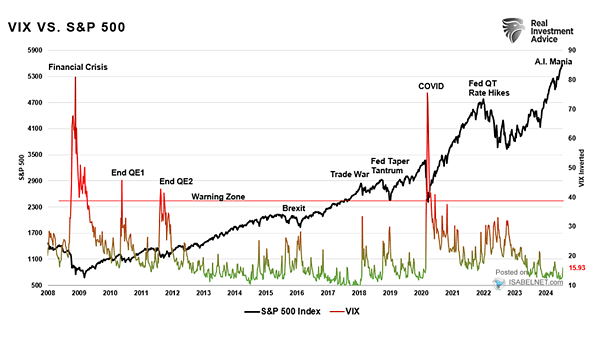
VIX vs. S&P 500

VIX vs. S&P 500 Compared with past oil shocks, the S&P 500’s drop looks measured. Investors seem braced for short-term turbulence rather than a structural shift in sentiment. The pullback feels more like caution than panic. Image: BCA Research

Fed Funds Rate vs. Gasoline Price / Core CPI

Fed Funds Rate vs. Gasoline Price / Core CPI When gasoline prices rise faster than inflation and move in step with growth, the Fed tends to lift rates. But what is the determining factor this time: strong demand or deep strain? It’s clearly the latter. Image: TS Lombard

Bloomberg Dollar Index One-Month Risk Reversals

Bloomberg Dollar Index One-Month Risk Reversals Currency markets are turning defensive, as demand for dollar upside and protection against violent swings gains pace amid Middle East tensions. Few things spook investors like uncertainty, and the greenback remains their safe haven. Image: Bloomberg

Quarterly Annualized Real U.S. GDP Growth

Quarterly Annualized Real U.S. GDP Growth Under the baseline, oil prices hit $110 in March and ease to $71 by 2026 Q4, pulling the projected 2026 Q4/Q4 US GDP growth down 0.3 percentage points to 2.2%. The hit to output looks modest given how sharp the oil price swing is. Image: Goldman Sachs Global Investment…

U.S. Dollar History vs. Neutral Value

U.S. Dollar History vs. Neutral Value Currency markets move more on expectations around interest rates, economic data, and geopolitics than on fundamentals. The U.S. dollar’s stabilization at neutral levels reflects Fed policy uncertainty and ongoing global tensions. Image: Real Investment Advice

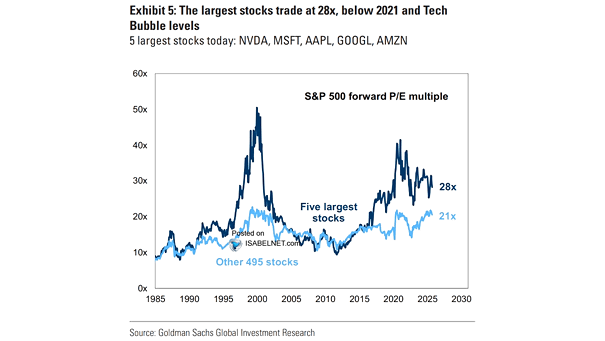
Valuation – S&P 500 Forward P/E Multiple

Valuation – S&P 500 Forward P/E Multiple Strong profits haven’t lifted valuations: the S&P 500’s P/E has narrowed as investors weigh geopolitical uncertainty and renewed oil price volatility. Sometimes solid results aren’t enough when risk appetite fades. Image: Goldman Sachs Global Investment Research

Market-Implied U.S. Recession Probability

Market-Implied U.S. Recession Probability Markets now price in just a 14% chance of a U.S. recession over the next year, keeping recession fears modest and consistent with a moderate-risk backdrop. Image: Goldman Sachs Global Investment Research

Volatility – VIX Index

Volatility – VIX Index Oil’s sharp swings on the latest geopolitical shocks help explain the elevated VIX. Calmer energy prices tend to bring volatility back down. For now, the oil tape is driving broader market mood. Image: MarketDesk Research

S&P 500 and Cross-Asset Volatility Stress

S&P 500 and Cross-Asset Volatility Stress Rising cross-asset volatility often signals growing fragility in U.S. equities. It is a cautionary signal, not a call on an imminent crash. It’s more of a yellow flag than a red one. Image: Bloomberg

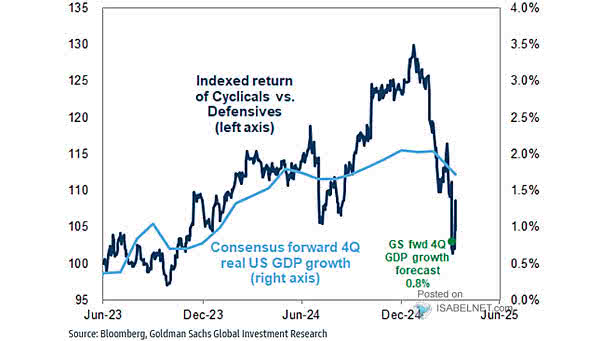
Indexed Return of Cyclicals vs. Defensives and Consensus Forward 4-Quarter U.S. GDP Growth

Indexed Return of Cyclicals vs. Defensives and Consensus Forward 4-Quarter U.S. GDP Growth Markets are leaning toward a slower-growth view. Relative returns between cyclical and defensive stocks point to roughly 1.4% U.S. real GDP growth, well short of Goldman Sachs’ 2.1% forward 4Q GDP growth forecast. Image: Goldman Sachs Global Investment Research