S&P 500 Intraday Swings
S&P 500 Intraday Swings Recent S&P 500 volatility, characterized by intraday swings exceeding 10% and VIX spikes echoing 2008 and COVID-era turbulence, appears to be stabilizing. Image: Bloomberg
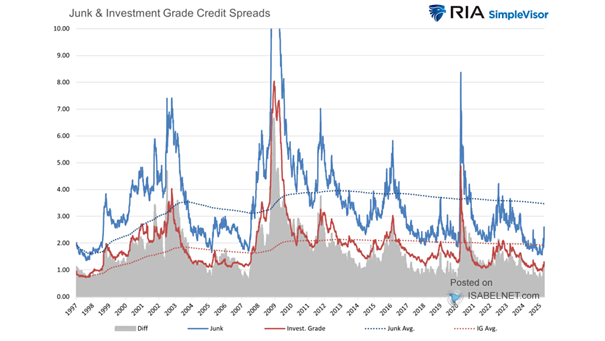
Junk and Investment Grade Credit Spreads Corporate bond yield spreads are often used as a gauge of financial market stress. They can provide insights into the likelihood of an economic downturn, but they are not foolproof predictors. Image: Real Investment Advice
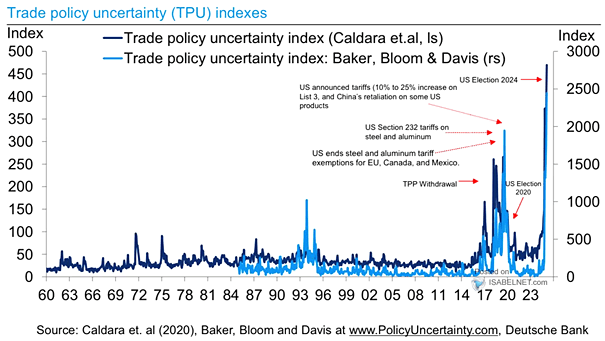
Trade Policy Uncertainty Indexes Uncertainty in trade policy often leads to positive future returns for the S&P 500, as markets tend to price in worst-case scenarios during unclear times. Once clarity emerges, stocks frequently recover. Image: Deutsche Bank
Average Monthly Volatility for U.S. Election Years Since 1928 The historical pattern of the VIX rising before U.S. elections and then rapidly plunging afterward is attributed to increased uncertainty and investor fear leading up to the elections. Image: BofA US Equity & Quant Strategy
Volatility and Macro Variables Macro variables pointing to a decrease in rates volatility are good news. Image: Goldman Sachs Global Investment Research
The Market Risk Indicator (Global Financial Stress Index) According to BofAML, the global financial stress index is a more accurate market risk indicator than VIX. Image: BofA Merrill Lynch Global Research
Equity Volatility vs. Equity Allocation As equity volatility rises (inverted on the chart), equity allocations come down. You may alos like “The Yield Curve Leads VIX (Volatility) by Three Years.” Picture Source: Deutsche Bank
S&P 500 1-Year Volatility vs. EPS Revisions This chart from SG shows a good correlation between earning revisions and the S&P 500 1-year volatility. You may also like “S&P 500 1-Month Volatility History Since 1928 and VIX Since 1990.” Image: Societe Generale Cross Asset Research