U.S. Household Equity Ownership vs. S&P 500 Index

U.S. Household Equity Ownership vs. S&P 500 Index U.S. households have never been this heavily invested in stocks. The higher the concentration, the greater the risk that a market pullback hits both confidence and consumption, reversing wealth effects. Image: Real Investment Advice

Market Capitalization of the Largest Stock Relative to the 75th Percentile Stock

Market Capitalization of the Largest Stock Relative to the 75th Percentile Stock U.S. stocks are more top-heavy than at any point in nearly a century, with mega-cap tech driving the charge. The dominance is juicing index gains—but also flashing warnings on risk and concentration. Image: Goldman Sachs Global Investment Research

Seven Largest Companies as Share of S&P 500 Total Market Capitalization

Seven Largest Companies as Share of S&P 500 Total Market Capitalization The seven largest stocks in the S&P 500 make up 34% of the index’s total market capitalization. Although such a high concentration doesn’t guarantee market declines, it has the potential to increase volatility. Image: Goldman Sachs Global Investment Research

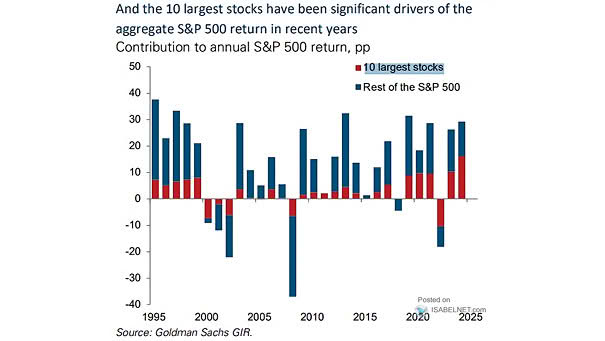
Top 10 Mega Cap Stocks as % of S&P 500

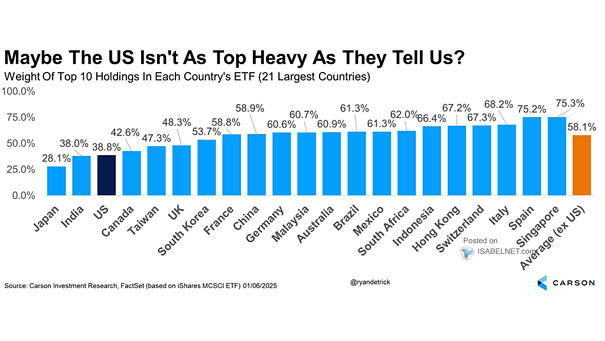
Top 10 Mega Cap Stocks as % of S&P 500 The growing dominance of the top 10 companies in the S&P 500 has raised concerns about whether the index still provides sufficient diversification, given the concentration risks and sector imbalances. Image: Real Investment Advice

Valuations – Spread of S&P 500 Minus S&P 500 Equal Weight

Valuations – Spread of S&P 500 Minus S&P 500 Equal Weight The significant valuation gaps between the cap-weighted and equal-weighted S&P 500 result from the high valuations and growth expectations of large companies, which emphasize market concentration and investment risks. Image: Bloomberg

Equal-Weight vs. Aggregate S&P 500 Annualized 10-Year Returns

Equal-Weight vs. Aggregate S&P 500 Annualized 10-Year Returns Given the high concentration in today’s S&P 500, long-term investors may benefit from considering an equal-weight strategy in the current market environment. Image: Goldman Sachs Global Investment Research

Top Five Companies % of S&P 500 Market Capitalization

Top Five Companies % of S&P 500 Market Capitalization The S&P 500 is experiencing unprecedented levels of concentration. While the concentration presents potential risks, the fundamentals of the top 5 companies remain strong, with elevated profit margins and robust cash flow generation. Image: Deutsche Bank

Market Capitalization of the S&P 493 as Share of Index Total

Market Capitalization of the S&P 493 as Share of Index Total The 493 smallest stocks in the S&P 500 now account for just 67% of the index’s market capitalization, a record low. This reflects a trend where a few large companies dominate, raising concerns about market concentration. Image: Goldman Sachs Global Investment Research

S&P 500 Top 5 Stocks’ Weight vs. 1-Year Forward Returns

S&P 500 Top 5 Stocks’ Weight vs. 1-Year Forward Returns While the current high market concentration is a significant feature of today’s market landscape, it doesn’t necessarily predict poor performance in the near term. Image: Goldman Sachs Global Investment Research

Correlation Between Top 10 and S&P 500

Correlation Between Top 10 and S&P 500 While the concentration of large-cap stocks in the U.S. equity market is a topic of discussion, the evidence suggests that its impact on market behavior is not as alarming as some might believe. Image: S&P Dow Jones Indices