The Impact of an Inverted Yield Curve

The Impact of an Inverted Yield Curve Great charts showing that a flat/inverted yield curve implies weaker U.S. GDP growth, lower equity returns, and higher volatility. Image: Pictet Asset Management

The Longest Economic Expansion in American History

The Longest Economic Expansion in American History The U.S. GDP has grown for 121 consecutive months since the Great Recession. This is officially the longest U.S. economic expansion in history.  You may also like “Strength of Economic Expansions.” Image: CNBC

Performance Based on Congress Makeup – Average S&P 500 Index Annual Return

Performance Based on Congress Makeup – Average S&P 500 Index Annual Return Since 1950, U.S. stocks have typically shone under a split Congress, posting an average annual gain of 15.1% as investors embrace the political gridlock that keeps sweeping policy changes in check. Image: Carson Investment Research

Valuation – Shiller Cyclically-Adjusted S&P 500 Price-to-Earnings Ratio

Valuation – Shiller Cyclically-Adjusted S&P 500 Price-to-Earnings Ratio By the Shiller CAPE’s measure, U.S. stocks are back in the stratosphere — the kind that’s thrilled investors on the way up, and burned them on the way down. It’s a level that has often meant thinner returns and rising risk. Image: Goldman Sachs Global Investment Research

Blended Money Supply

Blended Money Supply U.S. money supply is shrinking rapidly. Historically, U.S. nominal GDP growth has closely tracked money supply growth. Image: Deutsche Bank

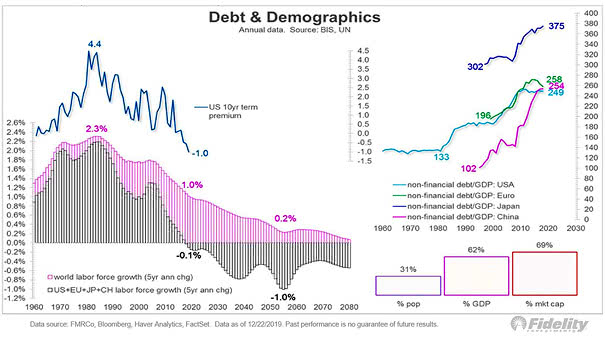
Debt, Demographics and Labor Force Growth

Debt, Demographics and Labor Force Growth The slowdown in the labor force in the U.S., China, Europe and Japan, represents 62% of the world’s GDP and 69% of the equity market capitalization. The labor force growth is expected to be -1% by 2055. Image: Fidelity Investments
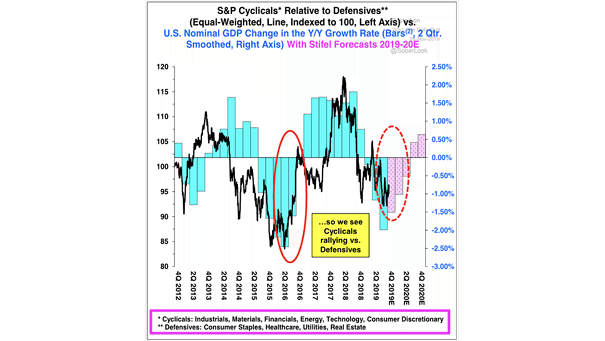
S&P 500 Cyclicals Relative to Defensives

S&P 500 Cyclicals Relative to Defensives Chart suggesting that S&P 500 cyclicals could outperform defensives in 2020, based on higher U.S. nominal GDP growth. Image: Stifel

Detecting and Measuring Asset Bubbles

Detecting and Measuring Asset Bubbles Detecting and measuring asset bubbles is not always an easy task. This chart puts into perspective the current U.S. households financial assets to GDP and the U.S. federal debt as percentage of GDP.