U.S. Bond ETFs Top Inflows Record
U.S. Bond ETFs Top Inflows Record In June, investors significantly increased their exposure to bond funds, as weak economic data fuels slowdown worries. U.S. bond ETFs inflows hit $25.4bn. Image: Financial Times
U.S. Yield Curve and Growth/Value P/E Ratio The chart below shows that the shape of yield curve explains nearly 50% of the variation in value vs. growth multiples. Actually, when the U.S. economy is sluggish, investors prefer growth stocks. Image: BlackRock, Inc.
Will Value Ever Outperform Growth? When the U.S. economy is weak, investors prefer growth stocks. But value could outperform again, when the U.S. economy will be stronger. Image: Ned Davis Research
Warning Signs of the Next Financial Crisis Some vulnerabilities in the global economy pose a risk for investors and could amplify the next financial crisis. Image: International Monetary Fund
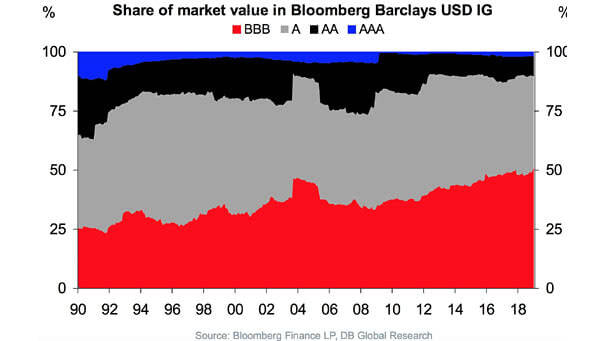
Value of U.S. Corporate Bonds by Rating Since the Great Recession, the U.S. corporate bond debt rated ‘BBB’ exceeds $3 trillion. If the U.S. economy goes wrong, this is bad news for investors. Image: The Wall Street Journal
Increased Number of Zombie Companies Artificially low interest rates and investor demand for leveraged loans have created zombie firms. Image: Jupiter Asset Management
Probability of US Recession is Rising Mike Wilson, chief U.S. equity strategist for Morgan Stanley, said that “Fed could cut as soon as July but it may not halt slowdown/recession.” Image: U.S. Global Investors
Fear Of Recessions? S&P 500 Bull and Bear Markets since 1946 A long-term investor should put downturns in perspective. Image: Charles Schwab
Brent Price vs. 10-Year Treasury Bond Yield vs. S&P 500 This chart shows that oil prices are a good indicator of global economic growth and investors are concerned about a global economic slowdown. Image: Pictet Wealth Management
Could European Stocks Outperform U.S. Stocks? This chart shows U.S. vs. European stocks at 70-year highs. Keep in mind that investors think that the euro area economy is less resilient than the U.S. economy in the event of a shock. Currently, the euro area economy is more impacted by the global slowdown than the U.S.…
New York Fed Probability of Recession in Next 12 Months since 1990 When an inverted yield curve occurs, short-term interest rates exceed long-term rates. It suggests that the long-term economic outlookis poor and that the yields offered by long-term fixed income securities will continue to decline. Since 1962, no recession has occurred without an inverted…