U.S. Election Scenario Probability

U.S. Election Scenario Probability As Republicans gain momentum heading into the U.S. elections, the prospect of their sweeping victory raises both hopes for short-term economic gains and fears of larger deficits and sustained inflationary pressures. Image: Deutsche Bank

Average Year for the S&P 500 during an Election Year

Average Year for the S&P 500 during an Election Year This election year appears to be among the strongest for the S&P 500 so far. Historically, the S&P 500 tends to experience a period of weakness leading up to the U.S. elections, followed by a potential rally towards year-end. Image: Carson Investment Research

S&P 500 and Odds of Winning U.S. Presidential Election

S&P 500 and Odds of Winning U.S. Presidential Election The rising odds for Trump in prediction markets have been closely tied to an upswing in S&P 500 prices, reflecting investor sentiment that aligns with potential changes in economic policy should he win the election. Image: Morgan Stanley Research

S&P 500 YTD Returns as of the End of September in Election Years

S&P 500 YTD Returns as of the End of September in Election Years The S&P 500 has demonstrated a remarkable performance in 2024, marking the best first nine months of an election year since 1950, driven by strong corporate earnings, resilient consumer spending, and investor optimism. Image: Carson Investment Research

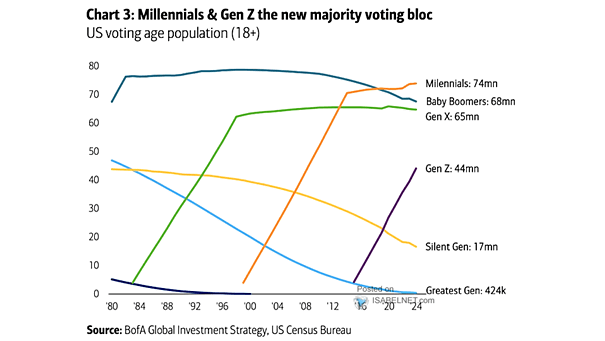
Elections – U.S. Voting Age Population

Elections – U.S. Voting Age Population Younger generations, specifically Millennials and Generation Z, are projected to become the new majority voting bloc in the upcoming 2024 U.S. presidential election, marking a significant generational shift in the electorate. Image: BofA Global Investment Strategy
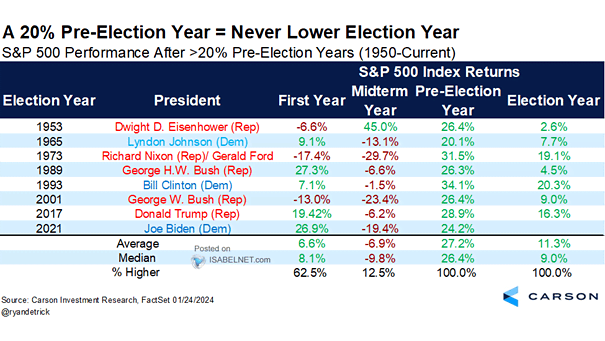
S&P 500 Performance After >20% Pre-Election Years

S&P 500 Performance After >20% Pre-Election Years Following a pre-election year gain exceeding 20%, the S&P 500 index has consistently shown positive growth during the election year, with an average increase in value of 11.3% since 1950. Image: Carson Investment Research

Volatility – VIX Curve and U.S. Election

Volatility – VIX and U.S. Election The historical trend of the VIX spiking before U.S. elections and then rapidly declining afterward can be attributed to heightened uncertainty and investor fear in the lead-up to the elections. Image: Morgan Stanley Research

Average Monthly Volatility for U.S. Election Years Since 1928

Average Monthly Volatility for U.S. Election Years Since 1928 The historical pattern of the VIX rising before U.S. elections and then rapidly plunging afterward is attributed to increased uncertainty and investor fear leading up to the elections. Image: BofA US Equity & Quant Strategy

VIX Average Trend in U.S. Election Years

VIX Average Trend in U.S. Election Years Historical patterns suggest that the VIX tends to bottom out in mid to late August, followed by a trend of increasing volatility as the U.S. Election Day approaches, driven by heightened market uncertainty. Image: BofA Global Research

S&P 500 Monthly Returns During an U.S. Election Year

S&P 500 Monthly Returns During an U.S. Election Year The S&P 500 has historically performed well in August during presidential election years, contributing to an overall positive market sentiment and potentially extending the summer rally. Image: Carson Investment Research