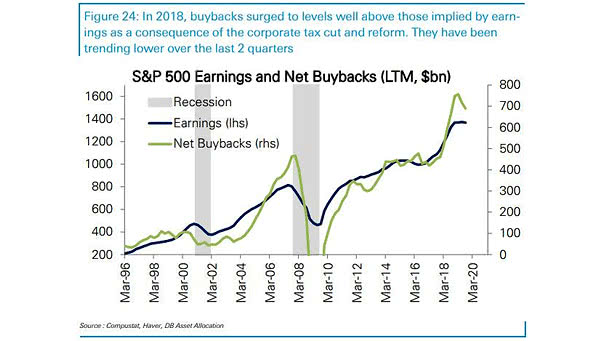
S&P 500 Earnings and Net Buybacks
S&P 500 Earnings and Net Buybacks Buybacks have been trending lower over the last two quarters. Deutsche Bank expects buybacks to slow to $625bn in 2020. Image: Deutsche Bank Asset Allocation
S&P 500 Earnings and Net Buybacks Buybacks have been trending lower over the last two quarters. Deutsche Bank expects buybacks to slow to $625bn in 2020. Image: Deutsche Bank Asset Allocation

Trade War – S&P 500 Peaks and U.S. Trade Policy What is the likelihood of a trade deal between the U.S. and China? Past market peaks have been followed by major trade escalations. Image: Deutsche Bank Asset Allocation
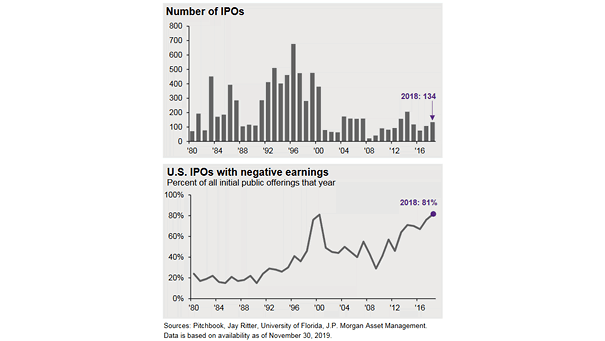
Number of U.S. IPOs and U.S. IPOs with Negative Earnings This chart shows the fall in new listings and the proportion of unprofitable U.S. IPOs at the highest level since the tech bubble. Image: J.P. Morgan Asset Management
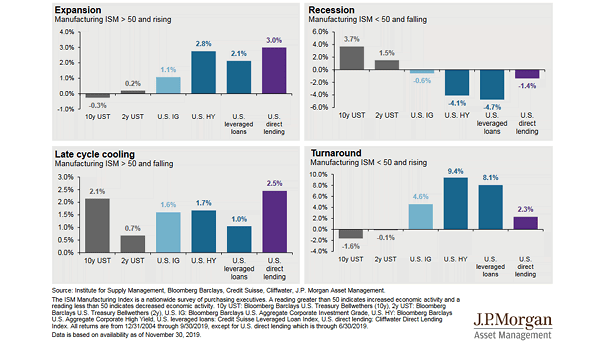
ISM Manufacturing Index and Credit Returns Across Economic Cycles Since 2004 If investors get the ISM Manufacturing right, they do well. Image: J.P. Morgan Asset Management
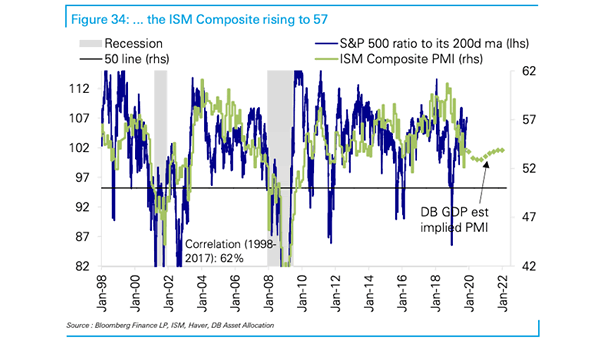
S&P 500 and ISM Composite PMI At current levels, the U.S. market is pricing in a strong rebound in the ISM Composite PMI rising to 57. Image: Deutsche Bank Asset Allocation

Valuation – Distribution of S&P 500 P/E since 1935 On a P/E basis, the S&P 500 is not cheap. The S&P 500 P/E has been higher only about 10% of the time since 1935. Image: Deutsche Bank Asset Allocation
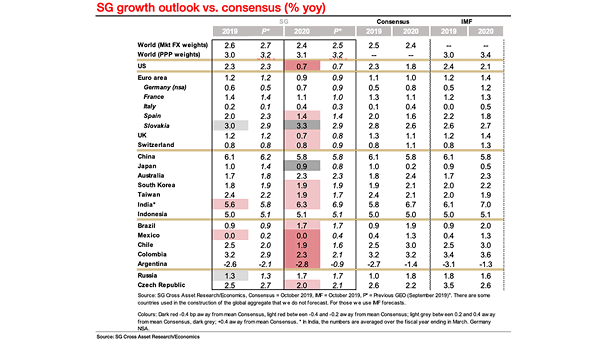
Global GDP Growth Outlook vs. Consensus SocGen remains below the consensus forecasts and expects a mild recession around mid-2020 in the U.S. and a projected U.S. GDP of 0.7%. Image: Societe Generale Cross Asset Research

S&P 500 and Mini-Cycles Chart suggesting that market participants have started to take into account the start of a fourth mini-cycle. Image: Societe Generale Cross Asset Research
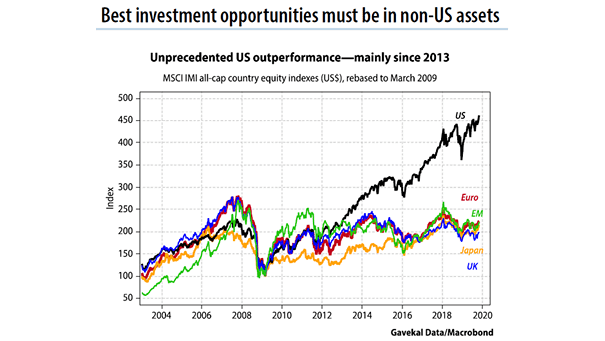
U.S. Equity Market Outperformance According to Gavekal, U.S. outperformance is mainly cyclical, not structural, and best investment opportunities could be in non-US assets. Image: Gavekal, Macrobond
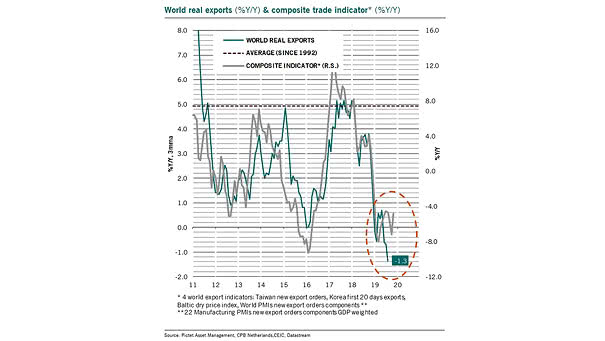
World Real Exports and Composite Trade Indicator Chart suggesting a recovery in world exports growth Image: Pictet Asset Management

Super-Cycles – Commodities, Stocks, and Bonds The importance of asset allocation and diversification: commodities, stocks, and bonds do not necessarily moved together over the long term. Image: Wells Fargo Investment Institute