S&P 500 – Investing at All-Time Highs vs. All Other Days

S&P 500 – Investing at All-Time Highs vs. All Other Days Investing at all-time highs tends to spook investors, but the data suggests otherwise: S&P 500 forward returns have typically looked much like those from any other day. Missing the market has usually cost more than buying at the top. Image: Carson Investment Research

S&P 500 and Prediction Market Odds of the End to the Iran Conflict

S&P 500 and Prediction Market Odds of the End to the Iran Conflict U.S. stocks advanced as the geopolitical mood brightened. The S&P 500 has followed every twist in expectations around the Iran conflict. Right now, sentiment is in the driver’s seat, not fundamentals. Image: Goldman Sachs Global Investment Research

U.S. 10 Year Yield and S&P 500

U.S. 10 Year Yield and S&P 500 For equities, focus less on where rates are and more on how fast they’re moving. U.S. stocks have rarely shown a strong link to the absolute level of rates, even when those levels are high by historical standards. Image: Deutsche Bank Asset Allocation

S&P 500 and Three Weeks of +3% Gains in a Row

S&P 500 and Three Weeks of +3% Gains in a Row The S&P 500 notched a third straight week of gains above 3%. Moves like this usually show up in snapback rallies after panic selling, not when stocks are hovering at record highs. Image: Bloomberg

Weekly Change in Equity Positioning

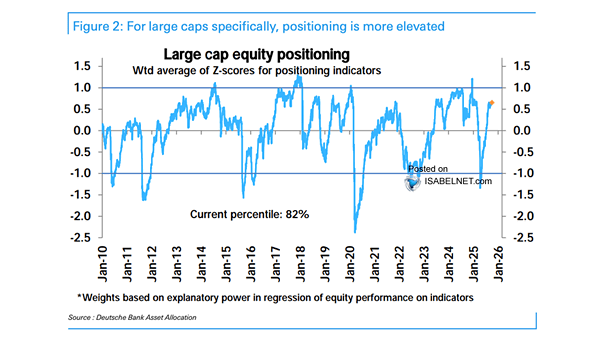
Weekly Change in Equity Positioning Investors piled into equities, driving one of the biggest weekly jumps in positioning on record. Such bursts often reflect a market gripped by FOMO. Image: Deutsche Bank Asset Allocation

Change in 12-Month Forward EPS for S&P Tech Sector Firms

Change in 12-Month Forward EPS for S&P Tech Sector Firms Nearly all of the year-to-date increase in S&P tech forward earnings traces back to SanDisk and Micron. Excluding those names, revisions look subdued and the growth narrative starts to look less convincing. Image: Bloomberg

MOVE Index vs. S&P 500

MOVE Index vs. S&P 500 The S&P 500 has been moving opposite to rate volatility. Stocks remain sensitive to rate swings, but as clarity returns, investors recalibrate and the market calms. It’s all about uncertainty, take that away and things settle fast. Image: Deutsche Bank Asset Allocation

S&P 500 vs. Forward EPS

S&P 500 Annual Rate of Change vs. Annual Change in GAAP Earnings The S&P 500 tends to track corporate earnings, so strategies built on profit growth make sense for investors playing the long game. In the end, it’s earnings that lift stocks and sustainable growth beats short-term noise every time. Image: Real Investment Advice

Nasdaq-100 Win Streaks of 12 Days or More and Future Returns

Nasdaq-100 Win Streaks of 12 Days or More and Future Returns A 12-day winning streak has pushed the Nasdaq-100 into rare territory. History is on the bulls’ side with similar streaks leading to positive returns one year out every time since 1985, averaging 19.4%. Image: Carson Investment Research

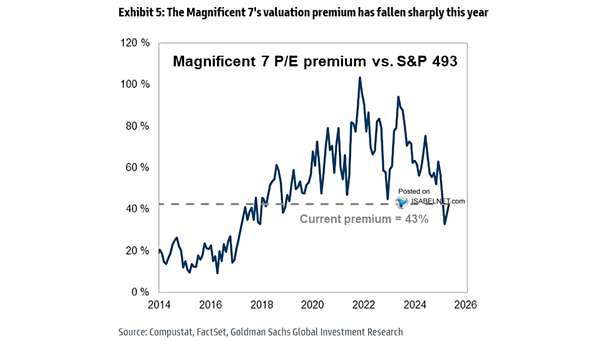
U.S. Stock Market Valuations – Combined P/E Ratio

U.S. Stock Market Valuations – Combined P/E Ratio U.S. tech stocks still command a premium over the broader market, fueled by strong growth prospects, though that gap looks unlikely to close unless a recession shakes investor confidence. Image: Topdown Charts

Rolling S&P 500 Change Over 11 Sessions

Rolling S&P 500 Change Over 11 Sessions It’s a rare burst of momentum: the S&P 500 has gained more than 10% in just 11 sessions, something that’s happened only 15 times this century. Moves like this remind us how unpredictable markets can be. Image: Deutsche Bank