S&P 500 Return Around First Fed Cut After Being on Hold for 6+ Months

S&P 500 Return Around First Fed Cut After Being on Hold for 6+ Months Historically, when the Fed resumes rate cuts after at least six months of holding rates steady, U.S. stocks have often posted strong returns in the subsequent 12 months, particularly if economic growth persists. Image: Goldman Sachs Global Investment Research

10-Year U.S. Treasury Yields with Various Moving Averages

10-Year U.S. Treasury Yields with Various Moving Averages When the Fed prioritizes the labor market over inflation, it can reduce the immediate risk of recession by sustaining employment. However, this is likely to increase inflation expectations and push yields higher. Image: J.P. Morgan

U.S. Real Yields and Gold

U.S. Real Yields and Gold Gold’s typical inverse link to real rates is fundamental, but inflation expectations, central bank buying, geopolitical risks, and investor sentiment driven by debt and fiscal worries can disrupt this relationship for extended periods. Image: Goldman Sachs Global Investment Research

S&P 500 Performance After 90-90 Days

S&P 500 Performance After 90-90 Days The NYSE “90/90 day” on Friday—when 90% of volume and stocks rose—is rare and bullish. Since 1980, such days often precede strong market gains, with the S&P 500 rising over 90% of the time a year later, averaging 23% gains.

S&P 500 Return After the Fed Waits Between 5-12 Months to Cut

S&P 500 Return After the Fed Waits Between 5-12 Months to Cut Since 1970, whenever the Fed has waited between 5 and 12 months to cut rates, the US stock market has delivered positive returns 90.9% of the time over the following 12 months, with a median gain of 14.5%—giving bulls plenty of reason to…

S&P 500 Earnings Revision Breadth

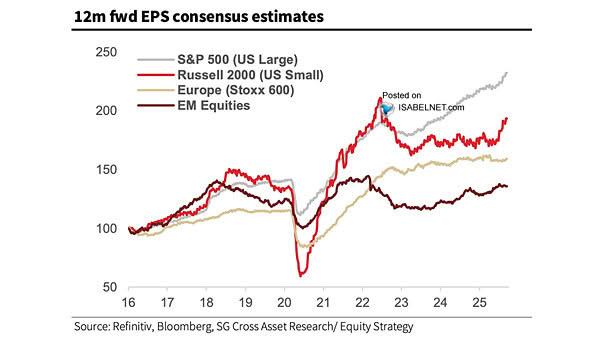
S&P 500 Earnings Revision Breadth The S&P 500 earnings revision breadth soaring highlights broad-based optimism, stronger-than-expected earnings results, and upward revisions pushing the index to record levels. Image: Goldman Sachs Global Investment Research

Valuations – Spread of S&P 500 Minus S&P 500 Equal Weight

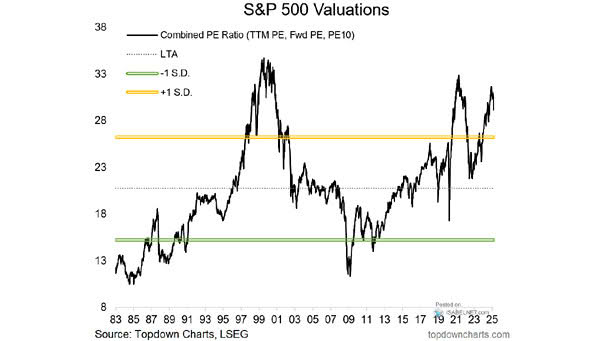
Valuations – Spread of S&P 500 Minus S&P 500 Equal Weight The significant valuation gaps between the cap-weighted and equal-weighted S&P 500 result from the high valuations and growth expectations of large companies, which emphasize market concentration and investment risks. Image: Bloomberg

Typical Path of S&P 500 Bottom-Up Consensus EPS Estimate

Typical Path of S&P 500 Bottom-Up Consensus EPS Estimate While positive earnings revisions have been strong recently, this momentum is likely to slow, though it probably won’t fall below the usual historical trend of downward revisions. Image: Goldman Sachs Global Investment Research

MOVE Index and Discretionary Investors Equity Positioning

MOVE Index and Discretionary Investors Equity Positioning Over the past few years, discretionary positioning has exhibited a strong inverse correlation with rates volatility, though this pattern can fluctuate based on market conditions and investor behavior. Image: Deutsche Bank Asset Allocation

Gold – Global Central Bank Holdings

Gold – Global Central Bank Holdings Central bank gold demand cycles respond to global economic and political factors. Recently, demand has increased amid financial instability, currency trust concerns, inflation, sanctions, and geopolitical conflicts. Image: Goldman Sachs Global Investment Research