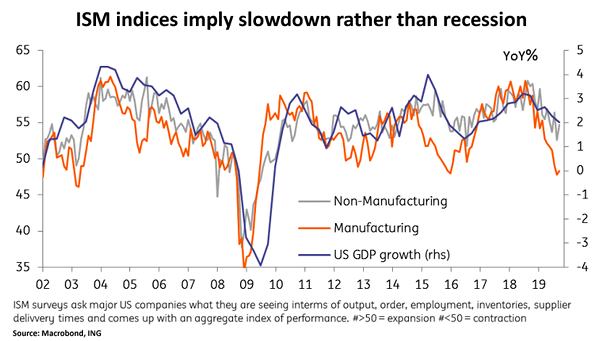
ISM Non-Manufacturing Index, ISM Manufacturing Index and U.S. GDP
ISM Non-Manufacturing Index, ISM Manufacturing Index and U.S. GDP U.S. ISM indices suggest a slowdown in the US growth rate, but not an imminent recession. Image source: ING Economics
ISM Non-Manufacturing Index, ISM Manufacturing Index and U.S. GDP U.S. ISM indices suggest a slowdown in the US growth rate, but not an imminent recession. Image source: ING Economics
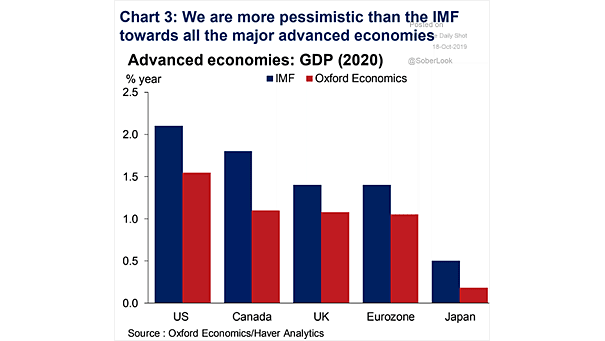
Advanced Economies – Global GDP Forecast for 2020 Oxford Economics thinks that IMF’s new global GDP growth forecasts for 2020 are too optimistic. Image: Oxford Economics

China Imports Lead World GDP This chart shows that China imports is a key factor of global growth, and clearly lead world GDP. Image: Oxford Economics, Macrobond
Global Composite PMI Leads Global GDP Growth Chart suggesting that the global composite PMI leads global GDP growth by 2 months. Image: Oxford Economics
U.S. Budget Deficits and the U.S. Dollar Pretty good correlation between U.S. budget deficits and the U.S. dollar over the past 30 years. The chart suggests that the U.S. dollar should weaken over time. You may also like “U.S. Twin Deficits (% of GDP) Lead Real Trade Weighted Dollar Index by Two Years” and “U.S. Dollar…
Philadelphia Semiconductor Index (SOX) Leads Global Manufacturing PMI by Three Months This chart suggests that the rally in semiconductor stocks may herald a global growth rebound. Image: Oxford Economics, Macrobond
U.S. Twin Deficits (% of GDP) Lead the U.S. Dollar Broad REER by 18 Months The chart suggests that the U.S. dollar should weaken over time. You may also like “U.S. Twin Deficits (% of GDP) Lead Real Trade Weighted Dollar Index by Two Years” and “U.S. Dollar and Relative Growth (GDP Spread)” and “U.S. Budget…
History of the Real Federal Minimum Wage Today, the real federal minimum wage is worth 31% less than in 1968. It is also the longest period without an increase (adjusted for inflation). You may also like “Wage Growth vs. U.S. Home Price Growth.” Image: Economic Policy Institute
Why the Fed Can’t Raise Interest Rates Above Inflation Rate, Today? The Federal Reserve can’t raise the Fed funds rate above the inflation rate because the US productivity growth is too weak.Net Domestic Investment to GDP is in a long-term downtrend and reduces productivity.This makes it difficult to see the Fed funds rate exceed the…