S&P 500 Earnings Growth – Consensus vs. Historical Norms

S&P 500 Earnings Growth – Consensus vs. Historical Norms Historically, S&P 500 earnings have risen 6.5% annually. The 18.6% call for 2026 is more than twice that rate, and forecasts for 2027 still around 16%. That kind of optimism tends to look compelling right up until it doesn’t. Image: Real Investment Advice

S&P 500 Bull Markets

S&P 500 Bull Markets Over the past 50 years, the average U.S. bull market ran for eight years and returned 288%. At just 3.5 years old and up more than 100%, this one still looks far from exhausted, leaving bears stuck in a painful squeeze. Image: Carson Investment Research

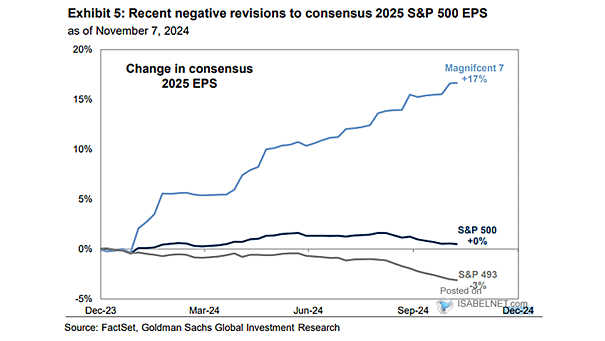
Magnificent Seven and S&P 500 ex Magnificent Seven Earnings Growth

Magnificent Seven and S&P 500 ex Magnificent Seven Earnings Growth After several quarters of narrowing performance between the Mag 7 and the S&P 493, the gap widened sharply again this quarter as the Mag 7 pulled decisively ahead. The concentration risk story isn’t going away anytime soon. Image: J.P. Morgan

S&P 500 Forward P/E Ratio and Subsequent 5-Year Returns

Forward P/E Ratio and Subsequent 5-Year Annualized Returns With U.S. equities still priced for perfection, the next five years may bring thinner returns. These are exceptional businesses, but price matters. Even the strongest names can disappoint if you pay too much. Image: J.P. Morgan Asset Management

S&P 500 Median Company EPS Growth

S&P 500 Median Company EPS Growth Earnings growth for the S&P 500 median company is running in the double digits, the strongest pace in four years, lifted by AI enthusiasm and confident outlooks from executives. Image: Deutsche Bank

S&P 500 Valuation – Shiller CAPE Ratio

S&P 500 Valuation – Shiller CAPE Ratio Shiller CAPE puts U.S. stocks back in the stratosphere, great on the way up, unforgiving on the way down. From these levels, history argues for lower returns and higher risk. Not a great starting point if you care about future returns. Image: Topdown Charts

S&P 500 Returns – Strong vs. Weak Periods

S&P 500 Returns – Strong vs. Weak Periods U.S. stocks tend to lose some of their edge over the summer, with May to October often lagging the stronger November to April period. Even so, seasonality is a guide, not a guarantee. Image: Real Investment Advice

S&P 500 Quarterly Net Profit Margin (ex. Financials & Utilities)

S&P 500 Quarterly Net Profit Margin (ex. Financials & Utilities) Corporate America is delivering solid profits, and with margins set to climb in the coming quarters, the bullish case keeps gaining traction. It’s getting harder to argue against that trend. Image: Goldman Sachs Global Investment Research
Earnings Growth – Mag 7 and S&P 500 ex-Mag 7

Earnings Growth – Mag 7 and S&P 500 ex-Mag 7 The Magnificent Seven are pacing for 32% earnings growth this year, more than double the S&P 500’s 15%. With tech momentum still running hot, betting against them looks like a tough call. Image: J.P. Morgan Asset Management

Share of S&P 500 Company Quarter-Ahead EPS Guidance Above Consensus Estimates

Share of S&P 500 Company Quarter-Ahead EPS Guidance Above Consensus Estimates Strong earnings and confident forecasts are keeping corporate America bullish on near-term profits, adding fuel to already rich valuations. As long as companies deliver, investors are willing to look past rich pricing. Image: Goldman Sachs Global Investment Research
Share of Global Market Capitalization

Share of Global Market Capitalization The U.S. accounts for only 4% of the world’s population, but it holds 62% of global equity value. Its innovation pipeline continues to pull in overseas capital. The simple truth: markets still move to a U.S. beat. Image: Goldman Sachs Global Investment Research