Probability of U.S. Recession Over the Next 12 Months

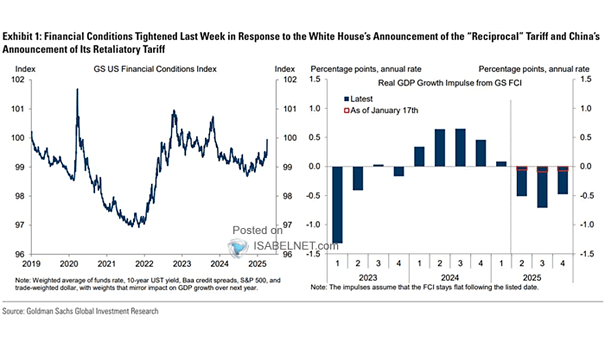
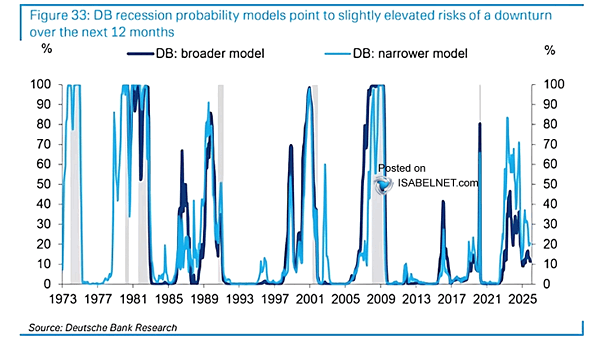
Probability of U.S. Recession In the Next 1 Year Goldman Sachs sees a 30% chance of a U.S. recession within the next year—higher than the long-run norm, but still pointing to only moderate downside risks. Image: Goldman Sachs Global Investment Research
Contribution of Sector Groups to S&P 500 Earnings Growth

Contribution of Sector Groups to S&P 500 Earnings Growth MCG and Tech have all but carried the market lately, fueling nearly 90% of the S&P 500’s earnings growth. Wall Street’s climb is still a tech‑powered story, with breadth across other sectors stubbornly missing. Image: Deutsche Bank Asset Allocation

Large Cap Equity Positioning

Large Cap Equity Positioning Markets overall are far from stretched, but in large-cap equities, positioning has climbed to the 82nd percentile, where momentum in big-name stocks is clearly picking up. Image: Deutsche Bank Asset Allocation

Change in Consensus EPS

Change in Consensus EPS Big Tech still runs the show—2026 earnings forecasts are racing higher for the giants, while the rest of the S&P 493 trail behind in their shadow. Image: Goldman Sachs Global Investment Research
S&P 500 Quarterly Earnings Growth

S&P 500 Quarterly Earnings Growth Deutsche Bank sees S&P 500 earnings accelerating, forecasting growth to climb from 9.3% last quarter to 10.7% in Q3, boosted by supportive macro trends and strong company performances—well ahead of the more cautious consensus. Image: Deutsche Bank Asset Allocation

S&P 500 Index and Barclays Equity Timing Indicator

S&P 500 Index and Barclays Equity Timing Indicator Barclays’ Equity Timing Indicator—a gauge of 19 market and economic signals—is tilting bullish, implying an 82% chance the S&P 500 rises over the next two months, with past setups since 2015 delivering roughly 4% on average. Image: Bloomberg

Small Cap Equity Positioning

Small Cap Equity Positioning Investors have been piling into small-cap stocks in recent weeks, with positioning jumping to a neutral 48th percentile—still leaving plenty of room for further upside. Image: Deutsche Bank Asset Allocation

S&P 500 Returns when New Highs Are Made in August, September, and October

S&P 500 Returns when New Highs Are Made in August, September, and October History is on the bulls’ side: whenever the S&P 500 has hit new highs in August, September, and October, the fourth quarter has never finished in the red since 1950—a track record market participants can’t ignore. Image: Carson Investment Research

Equities – MSCI U.S. vs. MSCI ACWI ex-U.S.

Equities – MSCI U.S. vs. MSCI ACWI ex-U.S. American equities are falling out of step with their global peers, lagging by roughly 9%—the biggest divide since 2009—amid currency shifts and a revival of interest in foreign markets. Image: Bloomberg

S&P 500 Quarterly YoY EPS Growth Relative to Consensus Expectations

S&P 500 Quarterly YoY EPS Growth Relative to Consensus Expectations Consensus sees S&P 500 earnings growth to cool to 6% in 3Q 2025 from 11% in 2Q, but Goldman Sachs thinks the bar may be set too low, pointing to stronger sales momentum and likely upside surprises from the Magnificent Seven. Image: Goldman Sachs Global…

S&P 500 Returns When New Highs Are Made In October

S&P 500 Returns When New Highs Are Made In October Bulls welcome October’s new highs, knowing the fourth quarter has been kind: markets have risen more than 90% of the time, with average gains of 4.9% going back to 1950. Image: Carson Investment Research